
Awkward conversations are the foundation of GOOD service
Have you ever had to question a person who is quietly angry at you about the details of that anger?
Not the most pleasant occupation. Depending on the situation you can get anything from denial — "No, no, everything is fine, the weather is just bad today" — to a bucket of crap a stream of unconstructive criticism.
People try to avoid conversations like that. But if you are trying to build good service, you have to push yourself into that ordeal again and again. It is called —
Collecting feedback
About three months ago I asked my friends and colleagues — Dzimka and Vádichka — to collect feedback about their services. The first one is responsible for IT development, the second for product initiatives. Their main client is the same person, our CEO.
They were not thrilled by my suggestion. Dzimka fairly pointed out that he would get either "Nah, guys, everything is fine" if the boss was in a good mood, or an uncontrolled shouting match. The first is harmless but a waste of time, the second is a waste of time and a test of self-control.
It is hard to blame the guys for going into that conversation only once.
Good service
People raise their voice when they think they are not being heard. A simple, instinctive reaction: if I was not heard, I will speak louder.
When a person tells you about their problem, it matters enormously to them that you give it your full attention. A person wants to be understood.
A person also wants to be helped with that problem.
The combination of the ability to listen and the willingness to help solve the problem is felt as care.
But how do you stay genuinely helpful when a client is practically spitting in your face?
Act rationally
If you look at any life situation as a game, and at "rationality" as the ability to win systematically 1, then "act rationally" can be read as "play so that you win in the end". What is left is to work out what kind of game "collecting feedback" is.
On rationality of this kind I recommend the book Harry Potter and the Methods of Rationality

Collecting feedback is one round of the game called "a long-term relationship with the client". And that is an infinite game. Its point is not to come first but to keep playing as long as possible.
In my opinion the optimal strategy in this game is to play the cartoon butler: calm, patient, unflappable.
That is the strategy. But what exactly do you do when things get out of hand?
When it smells of trouble
If the client comes running to you shaking their fists, the best thing Vadichka, for example, can do is follow an algorithm:
I borrowed this algorithm from Alexander Orlov's book "Jedi Techniques of Constructive Communication"

-
Gently move it to a one on one conversation, if the row started in public.
-
Ask: "What happened?"
Vadichka should skip this one if he already knows what happened. No need to test a shouting boss's patience for nothing. -
Ask: "What does that look like?"
As a rule, in answer to question №1 a furious person says something emotional, judgemental and unintelligible. Vadichka may be told that somebody is "bad" without any explanation of what bad thing that somebody did.
If it is all clear from the start, this question can be skipped as well. -
Ask: "And why is that bad?"
A very useful question when Vadichka, for example, gets a complaint that somebody did not do something. A line like "I was writing in the chat from 7 in the morning and nobody answered" means nothing by itself. But if the production server was down at that moment, it becomes immediately clear where the anger came from. -
Ask: "And what would you like? How do we solve this?"
The most important question. By this point the person feels that Vadichka has listened to them, understood them and now wants to solve the problem. The tension drops. -
Ask: "How will you know the solution works?"
If the solution offered in point №4 is worded vaguely, Vadichka is better off playing it safe and checking with this question whether he understood everything correctly. If it is all clear anyway, the question can be skipped.
When it smells of rot
When somebody is shaking their fists at you, calming them down is easy — 5 questions of the Orlov method and it is in the bag. Situations like that have honesty and clarity: the injured party is ready to demand and to go after what they want.
It is harder when a person does not fully understand what they want and is not sure they even have the right to demand it. The conflict is kept quiet, the resentment grows. Nobody wants to touch that sore subject. All the more so if there were rows before that led nowhere.
As I wrote in the previous article, suppressing a conflict leads to nothing good. So roll up your sleeves and work it through with Goldratt's conflict resolution diagram. And if you do not understand your opponent's position, or believe they are wrong (which is in fact the same thing), try what I call
The Socratic method
Take the role of note-taker. Literally: pick up a pen and a sheet of paper, lean over it, ready to write. Turn your camera on if you are talking online. It helps show the person that you are listening.
This is a free interpretation of Ward Farnsworth's book "The Socratic Method"
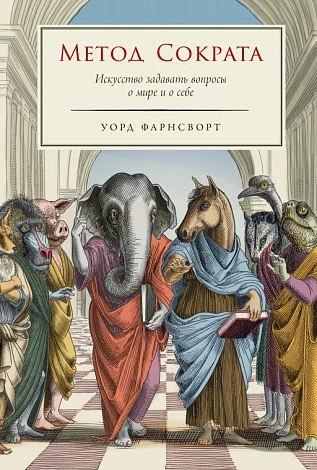
Ask the person gentle questions, trying to work out what they mean. The last thing you need is for the person to think your questions are a disguised attack. Do not forget: the game continues as long as your opponent is willing to answer. If every move of yours goes for a knockout, the person leaves the game.
You need to last as long as you can. Think of it as badminton: you want the game to be interesting and the fight to be passionate, but you also want the rally to last as long as possible.
Let us imagine a hypothetical conflict. Say Dzimka comes to our boss Andrey and asks for feedback about the service. And Andrey answers him:
— The IT service performs unsatisfactorily.
Dzimka has to help Andrey reword his statement into something more concrete — that is, into something objectively more convincing.
— Could you explain what you would mean by "performing satisfactorily"?
Like an archaeologist brushing away dirt, he keeps asking questions until the underlying principle is exposed.
Dzimka moves in small steps, pulling information out.
Dzimka uses questions of the form: "Why ... ?", "What for ... ?", "What does X mean to you?", "How would you describe the opposite of X?"
— I consider the IT service to be performing satisfactorily when it covers the needs of the business.
— And what is the need?
— 10 finished tasks a week.
Dzimka has no right at this moment to deny anything or to voice his own opinion. He is here only to ask and to listen.
He will not declare: "10 tasks is nonsense, we have never done that, where did you even get the idea that it is possible?!".
If Andrey believes 10 tasks is normal, the only person who can talk him out of it is Andrey himself. And that can happen if Andrey talks himself into a logical contradiction.
Waiting for that moment is not easy, Dzimka will have to put in effort and test his own patience. But it is all in his hands, because the discussion is run by the person asking the questions.
— Do I understand you correctly that a team which did 10 tasks would be considered good?
With the construction "Do I understand you correctly…" Dzimka clarifies the borders of the principle. Andrey should find it easy to agree with that statement — Dzimka will try to word it the way Andrey would have worded it himself.
— Yes
— Even if it is 10 minor bugs?
Dzimka slips in an obvious exception, one that formally fits the principle but does not fit its spirit.
Simple ways to find an exception to a principle:
-
Literalism. Come up with a statement that sounds absurd if taken literally:
"You have to ask permission before doing anything." — "Do I understand you correctly that I have to ask permission to go to the toilet?" -
Extremity. Walk along the edge of the statement:
"Everyone has to be at their desk at 8 in the morning." — "Do I understand you correctly that being even 1 second late is not allowed?" -
Change of perspective. Ask the person to try their own statement on themselves:
"Nobody is allowed to leave anywhere during the working day." — "Do I understand you correctly that you will now have to cancel your dentist appointment tomorrow at 15:00?"
If there are better options, use them. But if there are not, these three are always there.
— No, I mean 10 important tasks.
The situation that just arose is called elenchus. Andrey is forced to give up his previous statement. Now he has to formulate a new one, a more precise one.
For the rest of the conversation Dzimka will repeat this cycle:
- get a statement,
- generalise the statement into a principle,
- present an exception,
- elenchus, a new statement.
— And how do you tell an important task from an unimportant one?
Andrey may start protesting that Dzimka is nitpicking about words. But Dzimka will explain that he is clarifying in order to get to the bottom of it. The same words can mean different things to different people. And Dzimka wants to understand it thoroughly, not on the surface.
— The important ones bring us money.
— Do I understand you correctly that a team which did 10 tasks that brought money did well?
— Yes.
— Even if those tasks brought 1 euro of profit each?
— No.
— Then how much?
— At least X euro.
— Would it be right to say that a team which did only 5 tasks, but which brought 2 * X euro each, also did well?
— Quite.
— So 10 tasks is not the measure? What actually matters is the total amount of money brought in?
The technique of questioning is not a simple linguistic framework where Dzimka can just take Andrey's statement, put the word "why" in front of it and consider himself successful. Sometimes he will have to sweat to ask a good question.
— Yes, correct.
— Would it be right to say that a team which did only one task, but one so important that it brought 10 * X euro, also did well?
— Yes, agreed.
— In that case, is a team that did 20 business tasks well in a week, which in the end did not produce the expected return, considered bad?
— No, well, that did not depend on them. They did their job.
— Would it be right to say that a team which does not influence the final financial result and cannot choose the tasks it works on should still produce 10 * X euro a week?
— No, I think that would be unfair.
The state Andrey is in now could be called a knockdown, a disorientation. Five minutes ago he had a confident position, and he walked it into a logical contradiction. Right now he does not understand what he believes at all.
Having reached this point, Dzimka has no right to dance with joy and open the champagne. He has just hurt a person. It was necessary pain, pain that will make Andrey stronger. But it is unlikely that Andrey would be pouring out gratitude at that moment.
Dzimka's duty now is to hold out a hand and help Andrey save face. The last thing Dzimka needs is for Andrey to think he lost.
Dzimka understands that Andrey does not need his condescension. Andrey may be ready to accept for himself that he messed up, but Dzimka should not show in any way that he noticed. He has to be no less surprised by the conclusions than Andrey is.
Dzimka got what he came for: he cleared out that pile of hidden discontent, knocked the nonsense off the subject of the conflict, brought down the temperature of Andrey's righteous anger. But most importantly, he now understands better what matters to Andrey.
This whole conversation looks as if you are standing in front of your partner, holding their hand firmly and sweeping their legs, while not letting them fall. You keep going until the partner hangs off your arm in exhaustion, or until they learn to stand firmly on their feet.
Some would say this is bullying.
I believe that everything that can be destroyed by the truth should be destroyed. It will not kill my friend — on the contrary, it will make him tougher. And I have an interest in my friends getting stronger.